

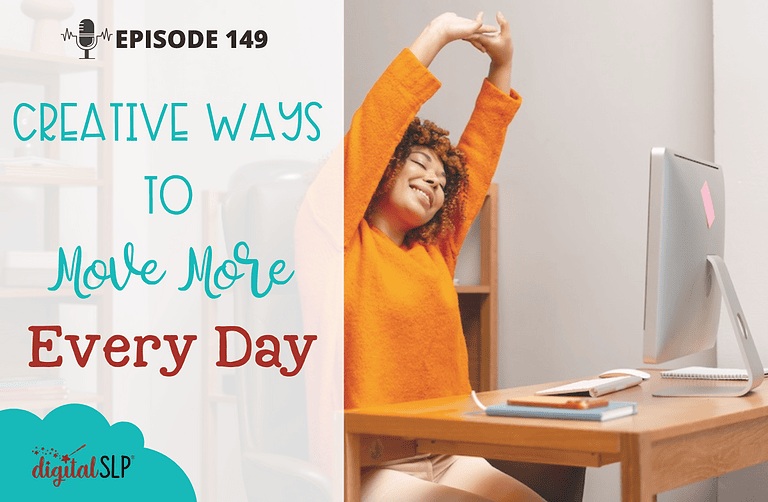
Finding time to exercise can feel overwhelming — especially during busy or exhausting seasons of life. In this episode, we talk about creative ways to move more every day without relying on structured workouts or all-or-nothing routines.
You’ll learn how to reframe movement as part of your daily life, explore low-pressure ways to increase physical activity, and discover habits that support energy, mobility, and mental well-being. This episode is perfect for anyone looking to move more consistently in a way that feels sustainable and supportive, not exhausting.
Full Transcript of Podcast: Creative Ways to Move More Every Day
Episode 149 - Creative Ways to Move More Every Day
Hey everybody, and happy new year! You are listening to the Speech Space Podcast, a podcast full of tips and resources for SLPs. I'm your host, Jessica Cassity, and this is episode 149. Today we're talking about something that sounds simple, but it actually can be pretty challenging in real life, and that's moving more during the day. Not in a train-for-race kind of way, and not in a way that requires extra time, extra gear, or a perfect schedule, but this episode is about practical yet creative ways to move more every day, especially if you're busy, working long hours, or just in a season where structured workouts just are not realistic. So if you've ever felt like if I can't do a real workout, what's the point? Then this one is for you. Before we dive in, I just want to mention that this podcast is brought to you by The Digital SLP, which features time-saving, interactive digital resources that are all tele-therapy platform-friendly.
You can learn more or sign up for a free 30-day trial by visiting thedigitalslp.com forward slash digitalslp. This is such a great time of year to reflect on the movement that we have throughout the day. One of the biggest mindset shifts is this. Movement doesn't need to be separate from your day. It can actually be woven into it. This sounds simple, but sometimes when we get in a groove, it can be hard to remember. So let's talk about a few examples. Walking around while you're taking phone calls, or stretching while something is warming up in the microwave, or taking the long way to the copier, or even just standing or pacing while you're planning or thinking. Now, none of these feel super impressive, and that's exactly why they work, because they're sustainable. You're not relying on motivation. You're just relying on your habits. Next, let's talk about pairing movement with something you already do. This is huge, and I alluded to this a little bit earlier, but you could walk while listening to your podcasts or audiobooks. You could stretch while you're watching TV, or you could do gentle movement during meetings where you don't need to be on camera. Another thing that you want to do is change positions often. Now, some of you might know this and some of you might not, but I actually had to have a back surgery last year. Well, actually, I guess it's the year prior. It was the end of 2024, and this is a big one for me.
So, changing positions often is key to reducing pain and stiffness for me. So, things like sitting, standing, pacing, alternating, all of those, the variety matters much more than the perfection of what you're doing. So, just switching things up is what is fundamental with that mindset. So, you just want to change. If you've been sitting for a while, you want to stand up for a while. If you've been standing for a while, you want to sit for a while. If you have a space where you can lie down for a few minutes, then that's even better, and you could add a little bit of walking or pacing back and forth in your office as well. Now, another way to weave movement in in a way that makes it more sustainable is to make movement social. Now, suggestions that I have for you are to do things like walk with a friend or make a habit of doing a family walk every night after dinner. Then, that movement actually doubles up as a connection. Now, you want to think often and not hard because this is also going to make it more sustainable for you. So, think about two minutes here or five minutes there.
It all adds up, and it's a lot easier for me. I don't know about you, but for me, it's easier if I'm like, okay, I'm going to go walk five minutes after lunch. That's a lot easier for me than trying to carve out 45 minutes after lunch and trying to figure out how I'm going to squeeze that into my day. Now, when we think of movement as energy or using movement for energy and not something that's really difficult, that can help as well. Movement should never feel like a punishment for what you ate or for what you didn't do. It should feel like support. So, on low energy days, think of incorporating things like slow walks or some gentle stretching. Any sort of movement counts. The goal isn't necessarily to burn a certain number of calories or get a certain number of steps. The goal is to support your nervous system, your circulation, and your joints, especially if you sit a lot or feel chronically tense. More movement often leads to more flexibility and can even give you more energy, especially if you're not overdoing it versus less energy. Now, we have to think about how to make these things stick without burnout.
Here's how movement actually becomes consistent. It's when we lower the bar, when we stop tracking everything, and we focus on how our body feels, not what counts. Now, this is a tricky one for me. I'm one of those with an Apple Watch, and when I forget to wear my Apple Watch for my walks, I admittedly sometimes am a little bit discouraged because I do like to get credit for my steps. So, this is a tricky one for me too. But if your movement routine feels fragile, like it only works on perfect days, it's probably too rigid. Sustainable movement should work every day, essentially. So, it should work on busy days, and tired days, or even just normal, regular days. So, if you take one thing from this episode, let it be this. You don't actually need more discipline. You need movement that fits into your life. So, taking small, frequent, and supportive movement breaks consistently is absolutely enough.
Thank you so much for tuning in, and don't forget that if you are interested in test driving some digital resources, head on over to thedigitalslp.com forward slash digital SLP to sign up for a free trial of Digital SLP. Thanks again for listening.







Recent Comments