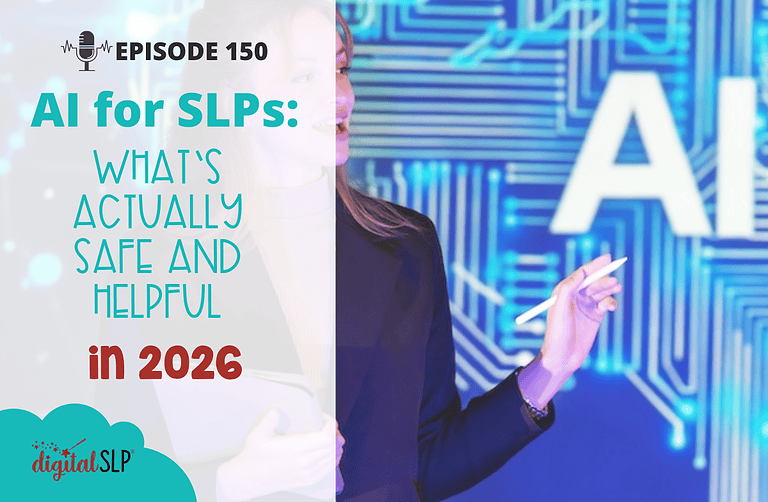
Artificial intelligence is quickly becoming part of everyday workflows—but many speech-language pathologists are unsure how to use AI safely and ethically. In this episode, we explore what AI actually means for SLPs in schools, healthcare, and private practice.
Full Transcript of Podcast: AI for SLPs: What’s Actually Safe and Helpful in 2026
Episode 150 - AI for SLPs: What’s Actually Safe and Helpful in 2026
Hey everyone, you are listening to the Speech Space Podcast, a podcast full of tips and resources for SLPs. I'm your host Jessica Cassity and this is episode 150. Today we're talking about something that keeps popping up in conversations, Facebook groups, conferences, and honestly probably in your own head too, and that is AI.
Some people are excited, some people are overwhelmed, and some people are thinking, should I be worried about this? So today we're cutting through the noise, no hype, no fear-mongering, just a realistic conversation about what AI actually is for SLPs, what's safe, what's not, and how to think about using it responsibly as we head into 2026. Before we dive in, I just wanted to mention that this podcast is brought to you by the Digital SLP, which features time-saving, interactive, digital resources that are all teletherapy platform-friendly. You can learn more or sign up for a free 30-day trial by visiting the Digital SLP forward slash digital SLP.
All right, so let's start here because this phrase gets thrown around a lot and sometimes in the past it had even confused me. So when people say AI might not be safe, they're not usually saying that AI is bad or dangerous for whatever purpose you're using it for in that moment. What they usually mean is using AI incorrectly can create problems, and most of these problems fall into three buckets.
We've got privacy, we've got accuracy, and then we have professional responsibility. These are just very real, very boring, but very important clinical and ethical considerations. So now that we have those categories outlined, let's go ahead and move on.
Now this is probably the most important thing to understand, but most free consumer AI tools are not designed for health care or schools. Now that means that you should not be pasting in student names, you should not be pasting in IEP details, and you should not be pasting in therapy notes with identifying information. Even if you think you've removed names, context can still identify someone.
So an example of safe verbiage that you can use when inputting into chat GPT or whatever the AI platform of your choice is would be something like this. Give me examples of an articulation goal for a seven-year-old who cannot produce the R sound. Now I'm going to contrast that with what would not be an example of something that's safe.
You could say something like, here's my student's evaluation and progress notes, can you rewrite them? That would not be an appropriate or safe use of AI. AI is best used for general support and not real client data. Here's another thing that people don't always realize.
AI can sound very, very confident while being very, very wrong. It might make up research citations, it might oversimplify complex disorders, and it might present something as evidence-based when it's actually not. That doesn't mean that AI is useless, it just means that you are the clinician who's in charge.
And you often need to fact-check AI if you're using it to supplement some research that you're doing. Think of AI like a very fast intern who is great at brainstorming and great at organizing ideas, but absolutely still needs a lot of supervision. If you treat AI as a starting point or a supplement and not a final answer, then you're definitely on solid ground.
Now this is where SLPs sometimes get uneasy whenever we're talking ethics and clinical judgment, and honestly that makes sense. Your license, your notes, your goals, your recommendations, those all have your name on them, not AI's. So using AI to do things like brainstorm therapy ideas or draft a parent- friendly explanation or even to organize session plans, those are all totally reasonable uses of AI.
Now using AI to decide what goals a child should have or using AI to replace clinical reasoning or auto-generate documentation without review, now that's where it crosses a line. Now the safest mindset is this, AI supports your judgment, it does not replace it. Now think back to that intern reference that I made earlier, it's kind of the same thing.
So now is AI worth using at all? I would say yes when it's used well. I think most of us would agree with that, maybe not everyone, but I think majority would say that AI has helped them in some way or another. AI can be incredibly helpful for reducing mental load, for saving time on administrative tasks, for helping you get unstuck if you're in a little bit of a creativity rut, and it can also help with supporting communication with parents and staff.
Now especially in a field where burnout is so real and time is so limited, you can see the value of AI. Now the goal though is to use it intentionally. That's the most important point if you take away anything from this episode, it's to use it mindfully and intentionally.
And you know the big thing too is that we don't need to fear AI, at least not yet. We don't need to jump on every new AI tool, but you just need clear boundaries, your own professional judgment, and a reminder that you are the biggest expert in the room. So AI does not replace speech-language pathologists, but it does support the work that we already do, especially when we use it wisely and intentionally.
If you found this episode to be helpful, share it with a colleague who's been unsure about AI, and don't forget that if you're interested in test driving some digital resources, head on over to thedigitalslp.com to sign up for a free trial today. Thanks again for listening.


Recent Comments